Simmons School of Education & Human Development
Subpages
General Information
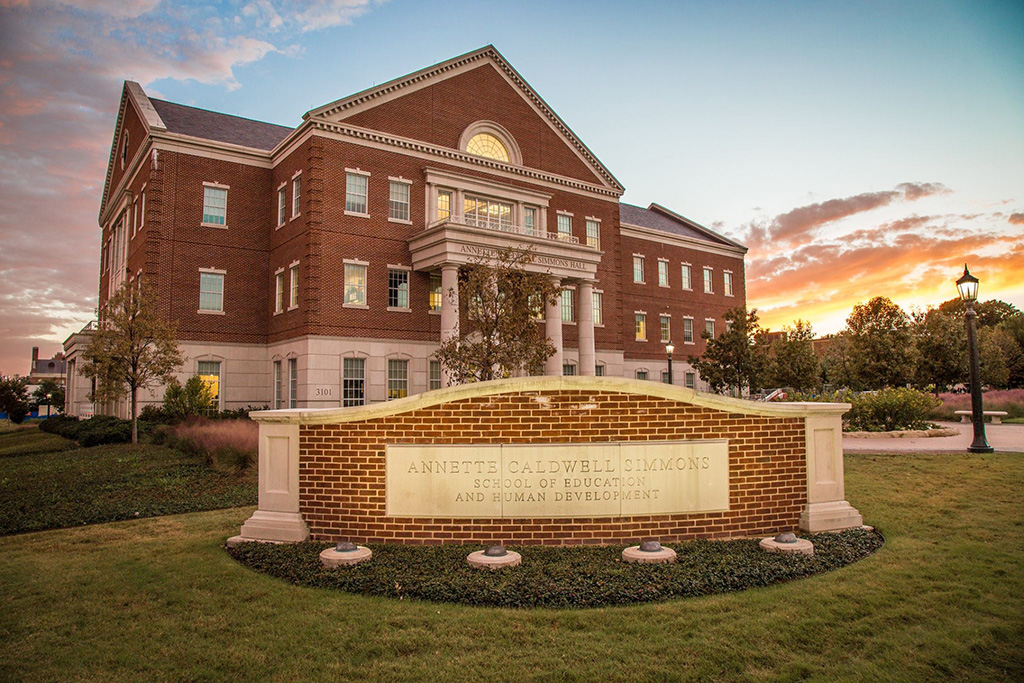
The Annette Caldwell Simmons School of Education and Human Development comprises research institutes, undergraduate and graduate programs, and community engagement centers that focus on teacher preparation, school leadership, higher education, counseling, sport management, applied physiology, sport performance leadership, applied social sciences, and conflict resolution. The mission of the school is to integrate the theory, research and practice of education and human development; to promote academic rigor and interdisciplinary study; to prepare students for initial certification and professional practice; to advance knowledge through research; and to nurture collaboration across the academic community.
The school’s graduate degree programs include four doctoral degrees, nine master’s degrees, and a number of graduate professional-preparation programs. Undergraduate programs include baccalaureate degrees and minors in educational studies, applied physiology, sport management, and sport performance leadership. The School’s academic departments are Teaching and Learning, Applied Physiology and Sport Management, Education Policy and Leadership, Counseling, and Human-Centered Interdisciplinary Studies.
The school is housed in Annette C. Simmons Hall and Harold C. Simmons Hall, which are among many LEED-certified buildings on the SMU campus. Key features include an integrated physiology laboratory; an applied physiology laboratory equipped with a data acquisition system, an environmental research chamber, and teaching pods; and the Center for Virtual Reality Learning Innovation that supports both research and teaching through the design and use of virtual reality, augmented reality, and mixed reality simulations and resources, including virtual avatars.
In an annual awards ceremony, the Simmons School recognizes its students, faculty and staff members who are regarded as leaders among their peers. Awards are given to students who have excelled academically, demonstrated uncommon leadership or engaged in community service in unique and meaningful ways. Faculty and staff members who have distinguished themselves through research pursuits, teaching activities, or professional accomplishments are honored. Additionally, University alumni who have made significant contributions of their time and resources to the school during the year are recognized.
The Department of Teaching and Learning represents SMU’s commitment to the professional development of educators through innovative, research-based undergraduate and graduate programs that are grounded in behaviorist, cognitive, social-constructivist and sociocultural perspectives and approaches to scholarship. All Teaching and Learning programs prepare educators who are scholars and leaders, experts in high-quality differentiated instruction, and able to translate research into practice. The department’s undergraduate and post-baccalaureate curricula prepare students for initial teacher certification. Master’s programs provide a solid foundation in research and theory and encompass areas such as technology-enhanced learning, STEM, early and late literacy, the learning sciences, education diagnostics, special education, learning therapy, bilingual education, ESL, urban education, and mathematics. A variety of enrichment opportunities serve the continuing education needs of practicing educators, and certification preparation programs are available in the areas of reading and learning therapy. Department faculty engage in high-quality research that combines quantitative and qualitative methodologies, contributes to scholarship, and influences pedagogical practices in early childhood through grade-12 schools. The Teacher Development Studio trains students to become effective teachers through the use of computer avatars that simulate K-12 classroom environments.
The Department of Applied Physiology and Sport Management offers undergraduate and graduate degrees. Undergraduate baccalaureate degrees and minors are offered in applied physiology and health management, sport management, and sport performance leadership. The department offers an M.S. in sport management and an M.S. in health promotion management, both of which are offered in collaboration with SMU’s Cox School of Business, and a Ph.D. in education with an emphasis on applied physiology. Students in the undergraduate and graduate programs have access to the department’s three laboratories. The Applied Physiology Laboratory is a teaching and research laboratory that utilizes experiential learning and comprises three complete and functional exercise physiology laboratories (teaching pods), a biochemistry lab, in-ground force plates, and a temperature- and humidity-controlled environmental chamber. The Integrative Physiology Laboratory engages in research that measures cardiovascular, neural, and thermoregulatory function in human health and disease.
The Department of Education Policy and Leadership is dedicated to the preparation and continued development of education policy and administrative leaders; the promotion of research, development, and analysis; and the translation of research into policy and practice at the local, state, national and international levels. Coursework and systematic applications of knowledge ensure that education leaders are able to implement and sustain effective organizational practices. In service to this mission, the department offers an M.Ed. in higher education leadership, an M.Ed. in PK-12 school leadership, an Ed.D. in higher education, an Ed.D. in pre-K through grade-12 education leadership, and a principal certification program.
The Department of Counseling offers the M.S. in counseling, which includes specialties in clinical mental health counseling; marriage, couple, and family counseling; and school counseling—all of which prepare students for professional licensure and certification. Concentrations are available in addiction counseling, child and adolescent counseling, trauma counseling, and LGBTQ+ affirmative therapy. Additionally, the counseling program operates the SMU Center for Family Counseling, which serves as a hands-on training clinic for graduate students and provides low-cost counseling services to the surrounding communities.
The Department of Human-Centered and Interdisciplinary Studies offers several interdisciplinary, skills-based master’s, doctoral, and certificate programs, including the Doctor of Liberal Studies, Master of Liberal Studies, Master of Arts in Dispute Resolution, Graduate Certificate in Dispute Resolution, Executive Leadership Coaching, Certificate of Advanced Graduate Liberal Studies, and Healthcare Collaboration and Conflict Engagement Certificate–all of which broaden students’ perspectives, insights, and understandings of the world. At the heart of the department’s curricular offerings is the belief that people can continue to grow intellectually, personally, and professionally throughout their lives.
The Simmons School’s research-intensive Doctor of Philosophy (Ph.D.) program prepares graduates to work in academic areas; to perform research; and to make significant contributions to research, policy, and practice in their fields of interest. Research concentrations include education, applied physiology, and education policy and leadership.